
Caldwell Parole and Probation Compared
Probation is community supervision ordered by a court, often instead of confinement. Parole is an early prison release allowed under older sentencing law and approved through the North Carolina Post-Release Supervision and Parole Commission. Post-release supervision is different from both. It is the mandatory community phase that follows many modern structured-sentencing prison terms. A person can leave a prison building yet remain active under North Carolina Department of Adult Correction authority.
The distinction changes what a Caldwell County result proves. An Active Probationer/Parolee result confirms a current NCDAC community status, not present jail custody. A parole result points to a prison sentence governed by the applicable older law. Probation may exist without any prison release in that case. Post-release supervision confirms that the prison part ended, but the whole sentence has not yet reached discharge. Read the inmate and community-supervision fields together before describing the person’s status.
| Status | How it begins | What the public record establishes |
|---|---|---|
| Probation | A court orders community supervision. | The person is supervised in the community; a prison release is not implied. |
| Parole | The Commission authorizes an eligible older-law prison release. | Prison custody ended under parole, while sentence authority continues. |
| Post-release supervision | A structured-sentencing prison term reaches its community phase. | The prison phase ended, but mandatory supervision remains active. |
- Discharge
- The formal end of the supervision or sentence status shown by the responsible agency.
- Absconder
- A person alleged to have avoided supervision or whose whereabouts are unknown.
- Inactive
- A historical NCDAC record with no current active inmate or supervision status.
Verify Caldwell Post-Release Supervision
Start with the NCDAC Offender Public Information search. It contains current and historical state corrections information dating back to 1972. It does not contain county-only jail stays. Search by offender number when known because NCDAC identifies that as the fastest method and says leading zeros are not needed. A name search can include first, middle, and last name, a sounds-like surname option, demographics, age or birth-date ranges, and status.
- Select Active Probationer/Parolee when checking for a present community status. Use All if the expected category is uncertain.
- Resolve same-name matches with the offender number and other displayed identifiers. Open the correct offender detail.
- Read Inmate Status and Probation/Parole/Post Release Status together. An active community field does not mean the person is incarcerated.
- Review the sentence blocks, actual release information, offense date, and movement history. These details help separate parole from probation or post-release supervision.
- Use the district office for general reporting or routing questions. Do not expect the public search or office to disclose confidential case notes.
The NCDAC criminal offender searches page states the county-jail limit directly. Thus, a missing Caldwell County Detention Center record cannot be resolved by assuming NCDAC should have it. If the matter never entered state custody or supervision, the sheriff’s commitment/release report and court file remain the right sources. The broader Caldwell County released-inmate search path explains that county record route.
Caldwell Supervision Office Contacts
Caldwell County belongs to Community Supervision Judicial District 25 with Burke and Catawba counties. The live NCDAC office-navigation page is the best starting point for current routing. A directory dated July 15, 2024 listed the district office in Valdese. Since that directory is dated, verify the address and phone numbers on the live office page before travel or time-sensitive contact.
The office is an organizational contact, not a public window into a person’s whole file. North Carolina law makes community-supervision records confidential under G.S. 15-207. Public search fields may establish that supervision is active, but they do not promise an officer’s identity, a private address, detailed conditions, or supervision notes. A caller can ask where a general reporting question belongs and can supply the offender number to reduce mistaken identity.
Judicial District 25 Office
309 Colombo Street SW, Suite 104
Valdese, NC 28690
828-432-2853 or 828-437-7452
Fax: 828-432-2841
Contact details are from the July 15, 2024 directory; confirm through the live NCDAC listing.
Community Supervision Main Office
2020 Yonkers Road
4250 Mail Service Center
Raleigh, NC
919-716-3100
The official district navigation can be viewed before choosing an office.
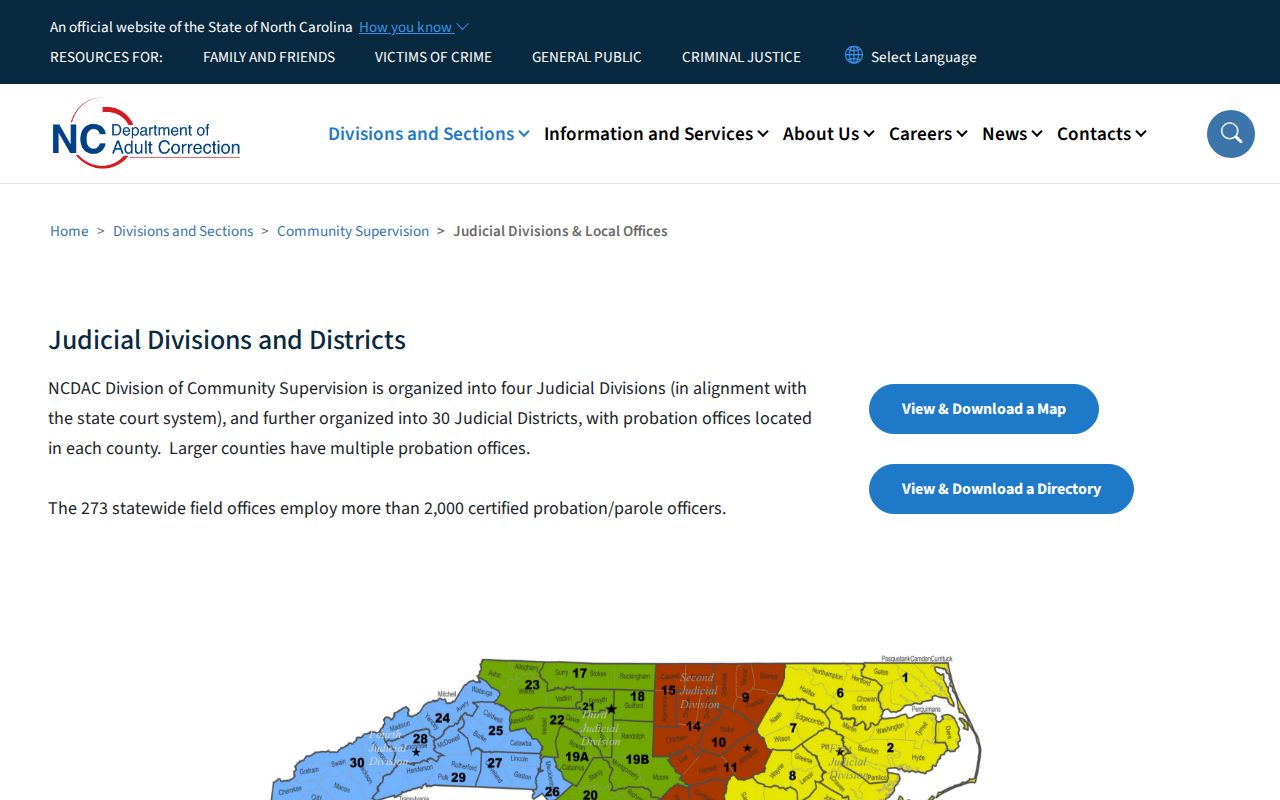
That navigation layer helps confirm the district structure without relying solely on the older directory entry.
Caldwell Absconder Status Checks
NCDAC maintains a separate public Absconder Search. An absconder is someone alleged to have avoided supervision or whose whereabouts are unknown. The label does not establish that the person is in the Caldwell County Detention Center. It also does not prove a new release or supply the full facts behind an alleged violation.
Probation, parole, and post-release supervision each carry conditions set by the controlling court or corrections authority. The public lookup does not display the full terms. A reported violation or unknown whereabouts should therefore be described as an allegation or status entry, not as proof of revocation, new custody, or discharge. Check the current offender detail before drawing any conclusion.
Resolve the identity first, then compare the absconder result with the live offender detail. A current inmate field may show that custody has changed since the absconder record was created. The public detail can clarify the broad status, while the confidential supervision file may contain terms, reports, and response decisions that are not displayed. For an immediate custody question, check the originating custodian rather than treating an absconder entry as a warrant return.
The official absconder form shows which fields can be searched.
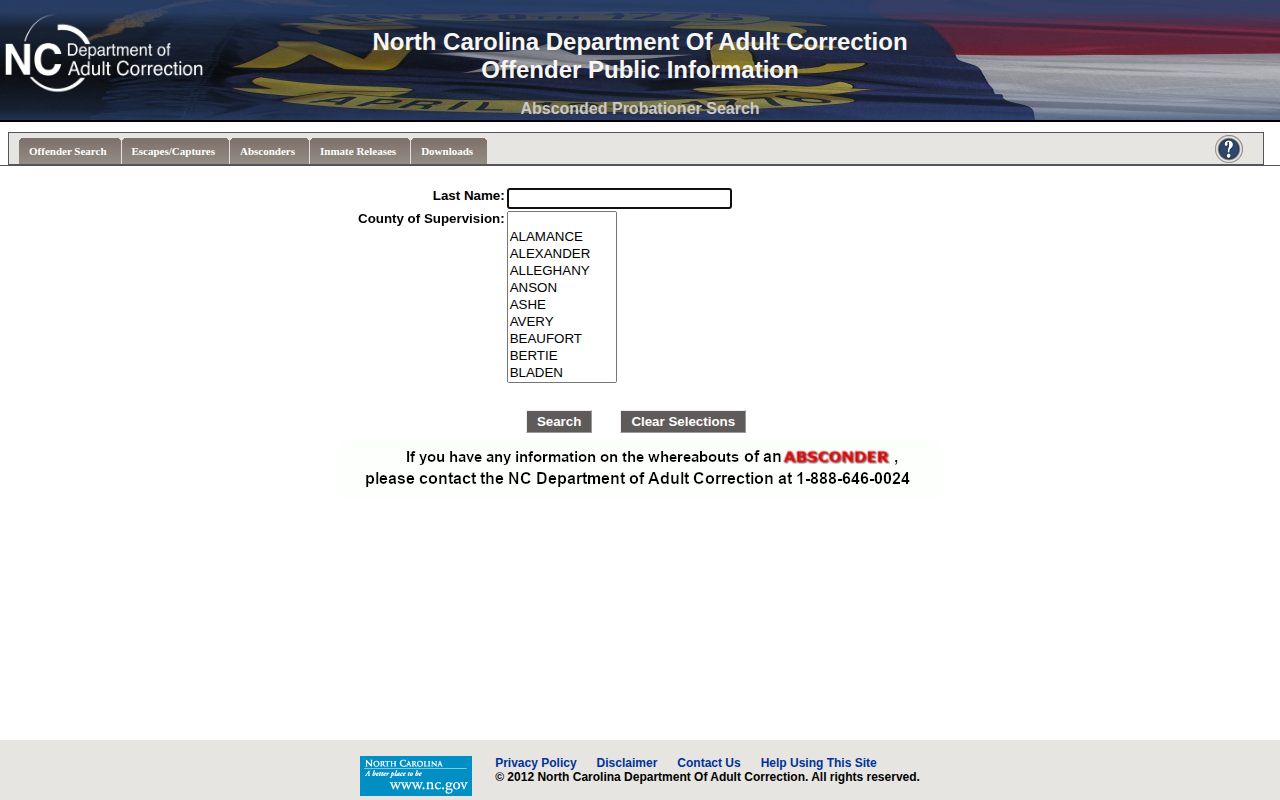
Its separate design reinforces that an absconder check and a general supervision-status check answer different questions.
NC SAVAN, also called VINELink, may provide custody or supervision change notifications for a selected person. It is free and anonymous according to the official state snapshot. A notice is a timely lead, not a certified supervision or discharge record. Confirm a county notice with the sheriff, and confirm a state supervision change through NCDAC.
Note: An absconder label describes an alleged supervision problem; it does not establish where the person is held or whether a new release occurred.
Caldwell Parole Review Results
North Carolina does not publish a conventional future calendar of face-to-face parole hearings. The Commission explains that members generally review files and vote independently. The official Discretionary Parole Reviews page supplies monthly decision reports instead. Calling those reports a hearing schedule would misstate the process.
Published outcome categories can include incomplete decision, suspended decision, regular parole, community-service parole, early medical release, 90-day mandatory parole, and statutory denial categories. The reports are limited public disclosures because the underlying files are generally confidential. Eligibility depends heavily on the offense date and sentencing law. Modern Structured Sentencing removed discretionary parole for most offenses committed on or after October 1, 1994, while some older cases remain eligible under Article 85.
The official monthly results page shows how review information is released.
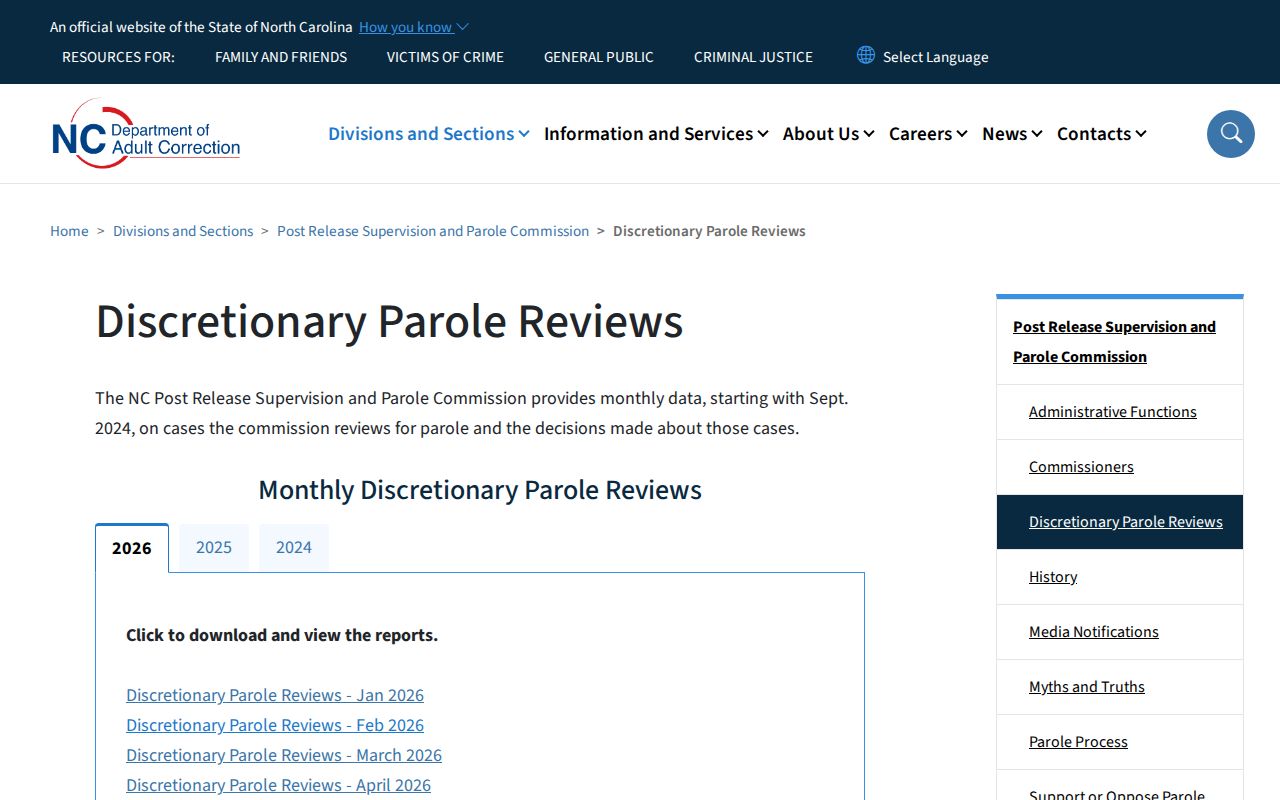
Use the month’s result with the offender detail and offense date rather than applying a broad parole formula.
Fair Sentencing felonies from July 1, 1981 through September 30, 1994, with terms of at least 18 months may involve 90-day mandatory parole near the end of the term. Other exclusions and cadence rules apply. Article 85 and the Commission are the sound sources for a specific eligibility question. NC SAVAN does not provide parole-review notice; Commission or Victim Support registration is a separate route.
Caldwell Supervision Records and Privacy
North Carolina’s public-records law draws a line between public status data and protected supervision material. NCDAC says basic conviction, time served, sentence length, admission, and release dates are public. Community-supervision files are confidential under G.S. 15-207. Juvenile, sealed, expunged, investigative, and security-sensitive material may also be restricted.
Use the public offender detail to establish only what it displays. Ask NCDAC’s Public Records office for an existing public record by offender number, name, and narrow date range. A request can seek public admission, release, and sentence data, but it should not demand confidential notes or require staff to create a new explanation. If material is withheld, ask for the legal basis and any segregable public portion.
North Carolina Public Records Act provisions govern access and copies, while criminal-investigation rules can restrict certain law-enforcement material. A court expunction can remove public case visibility under the statute that applies to the case. It does not turn an old search result into proof that no record ever existed. The current agency record remains the best evidence of present supervision.
Caldwell Reentry Support After Release
Caldwell County has two distinct local reentry settings. Caldwell PORT works with people inside the detention center by application and offers free treatment navigation, transport help to treatment, testing, and peer support. Its peer specialists and community paramedics can help connect a person with detoxification, rehabilitation, inpatient care, or medication-assisted treatment options. PORT is a support channel. It does not decide parole or probation status and does not issue release records.
Caldwell Correctional Center is separately designated by NCDAC as a reentry facility. The state prison offers work release, community work squads, education, substance-use programs, and reentry life planning. A person leaving that prison follows the NCDAC release and supervision path, not the Caldwell sheriff’s jail roster. Local services may support the return to the community, while the state offender detail remains the record for an active post-release or parole status.
For PORT access, the county lists 828-426-8542 and weekday walk-ins from 8 a.m. to 5 p.m. A supervision reporting duty still belongs with NCDAC. Keeping those roles separate avoids asking a care navigator to verify a legal status or asking a supervision office to supply treatment transport.
Note: Caldwell PORT and the state prison’s reentry programs provide support, but neither replaces the official NCDAC supervision record.
Caldwell Supervision Discharge Records
Supervision ends through the authority shown in the controlling sentence and agency record. Do not infer discharge from a person’s absence from one search result. An inactive NCDAC status generally means the person has no current active inmate or supervision status, but identity and sentence history still need review. Actual Release Date proves an accomplished prison exit, not the later end of parole or post-release supervision.
Read the most recent status with the sentence blocks and any public discharge entry. If the record changes from active community supervision to inactive, date the observation and use NCDAC for confirmation when exact wording matters. A court judgment may explain probation length or later action, while the state record shows the agency’s current category. Full discharge should be described only when the responsible record supports it.
The North Carolina Post-Release Supervision and Parole Commission can be reached at 919-716-3010. Victim Support lists 1-866-719-0108 for eligibility and status assistance. These channels can help route a question, but public monthly review results and offender status fields remain distinct records with different purposes.