
Caldwell Projected Versus Actual Release
NCDAC uses the exact field label Projected Release Date. The date reflects the sentence structure and credits recognized in the record at that time. It can move. By contrast, Actual Release Date is historical and records an accomplished state-custody event. Once a prison exit occurs, the actual date and current status provide stronger proof than the former projection.
The distinction also prevents a common error. An active post-release or parole status after the actual date means prison confinement ended while community supervision continues. That is not full discharge. A transfer to another prison or custodian is a movement, not a community release.
A person awaiting trial at Caldwell County Detention Center may have bond conditions or a future court event, but those are not a set jail-release date. Another case, warrant, or hold can prevent release even after one court action. The sheriff's commitment and release report records the physical event after it happens.
Find a Caldwell Release Date
Start with the last known custodian. Caldwell County Detention Center is operated by the sheriff. Caldwell Correctional Center is an NCDAC state prison. Their similar names do not make their records interchangeable.
- Identify whether the person is pretrial, serving a local jail sentence, or serving a state-prison sentence.
- For state prison, open the NCDAC Offender Public Information search. Search by offender number when known, or use name and identity fields.
- Open the correct offender detail and read Projected Release Date, Inmate Status, current location, sentence blocks, and any Actual Release Date.
- For a Caldwell jail sentence, compare the court judgment, sentence length, jail credit, and the detention center's calculation.
- For a pretrial detainee, review eCourts for bond and judicial action, then call the jail for present custody. Do not turn a court date into a promised release date.
- When release occurs, confirm it through the source record rather than relying on the old projection.
The NCDAC search form is the starting point for state custody and supervision:
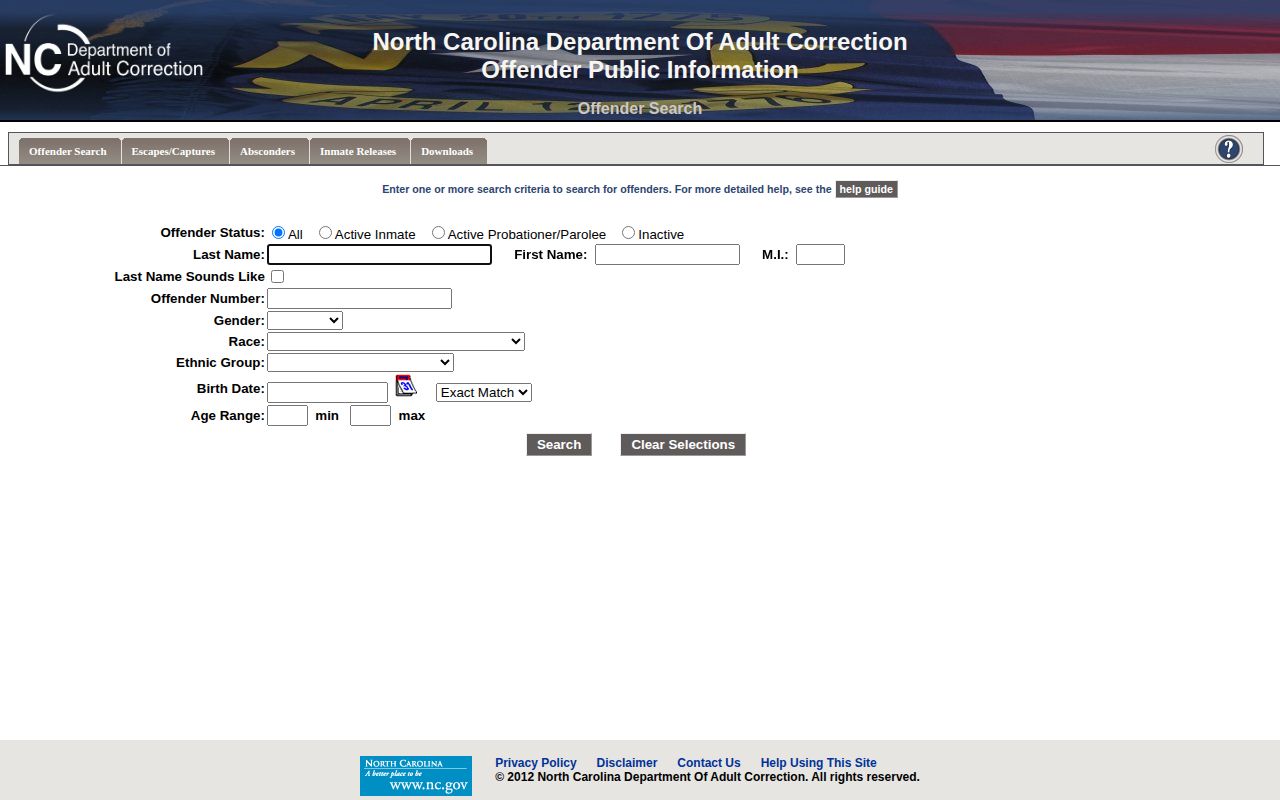
The form includes name, offender number, demographic, and status options. NCDAC says the database covers state prisons and state supervision, not county-only jail stays.
Caldwell Release Minimums and Maximums
North Carolina Structured Sentencing applies to offenses committed on or after October 1, 1994. NCDAC explains the framework as service of 100 percent of the judicial minimum and approximately 85 percent of the maximum. The percentage is shorthand for the structure. It is not a rule that lets anyone subtract 15 percent from any sentence.
G.S. 15A-1340.13(d) allows earned time to reduce a felony maximum, but never below the judicial minimum. The minimum is the floor. Credits can move the projected endpoint from the maximum toward that floor when the governing rules allow them. Offense date, sentence class, concurrent or consecutive terms, prior confinement credit, and later court orders all affect the result.
Older Fair Sentencing cases use different gain-time, good-time, and merit-time concepts. Those cases cannot be calculated with a modern Structured Sentencing shortcut. NCDAC offender detail and sentence history should be read with the judgment because more than one sentencing scheme may appear in older records.
- Judicial minimum
- The minimum term imposed by the court under the applicable sentencing law.
- Maximum
- The outer term from which lawful earned time may reduce the projected prison endpoint.
- Earned time
- Credit governed by NCDAC rules, often linked to qualifying work assignments or full-time programs.
- Jail credit
- Credited confinement time applied under the judgment and governing law.
Caldwell Earned-Time Release Rules
G.S. 148-13 directs NCDAC to adopt earned-time rules. NCDAC says a structured-sentencing prisoner may earn time through a qualifying work assignment or full-time program. Such credit moves the maximum toward the minimum. It does not cross the judicial minimum.
The same statute extends an earned-time framework to sentenced local-jail prisoners through local administrators. Misdemeanor sentences have their own provisions. G.S. 15A-1340.20(d) addresses activated misdemeanants and permitted credits within its statutory limits. Each calculation depends on the actual judgment and legally recognized credit, not a general web formula.
Discipline can affect credits under the applicable rules. Work or program participation may change. A resentencing, vacatur, correction to prior jail credit, or later legal change can also alter the projected date. For that reason, record the date on which any projection was viewed.
Note: A projected date is a current calculation snapshot, while the judgment and later correctional entries explain why that snapshot may change.
Why Caldwell Release Dates Change
Some changes arise from sentence administration. Others come from a court or another agency. The record should identify the cause before a later date is treated as an error.
| Factor | Possible effect | Where to verify |
|---|---|---|
| Work or program credit | May move a maximum toward the minimum under applicable rules | NCDAC sentence and program records |
| Disciplinary action | May remove or alter eligible credit | NCDAC offender and institutional record |
| Consecutive or concurrent terms | Changes how sentence blocks combine | Judgment and NCDAC sentence history |
| Jail-credit correction | Can move the computed endpoint | Court order and correctional record |
| Resentencing or vacatur | Can replace or end the prior computation | Official court file |
| Detainer or other hold | May prevent community release despite one sentence endpoint | Custodian and holding agency |
| Eligible parole action | May affect an older-law prison exit | Commission record and NCDAC detail |
Future BOP dates can also change after federal recalculation, but BOP is a different system. ICE or USMS custody following a Caldwell exit must not be folded into a state projected-date calculation.
Read Caldwell Sentence Blocks
NCDAC offender detail can contain more than one sentence block. Each block may show its own conviction county, docket, offense, conviction date, admission date, minimum and maximum term, sentence status, projected date, and actual date. Match the Caldwell case before selecting a date. A past term can remain visible beside a newer active term, and the oldest or most prominent date may not control current custody.
Current and previous location fields add context. A movement date can show that the person changed prisons without leaving NCDAC. Inmate Status should be read beside Probation/Parole/Post Release Status because prison release and community supervision are separate stages. A photo helps identity but does not prove that the chosen sentence block is the right one.
The dedicated monthly Inmate Release Search is built for accomplished state releases. It accepts county, year, and month or surname and can return offender number, Release Date, primary offense or qualifier, and Type of Release. Caldwell is county code 14 in that tool. The county choice is a state-release coding field, not a list of all people who left the Caldwell County jail.
When the detail and monthly result appear inconsistent, record both observations and ask NCDAC about the public admission and release data for the identified offender number. Do not merge separate terms into a new calculation.
Caldwell Release and Supervision
Many structured-sentencing felony releases lead into post-release supervision. G.S. 15A-1368.2 governs the transition and calculations tied to that supervision period. Depending on the class and statutory maximum structure, the prison-release point reflects the maximum less the prescribed supervision period and earned time.
That is why an actual prison-release date is not always a full sentence-discharge date. NCDAC offender detail may show an Actual Release Date alongside an active Probation/Parole/Post Release Status. Read both. The public status can confirm the category, while detailed community-supervision files are confidential.
VINELink can give a change alert for a participating record. A pending Caldwell County release may be tracked through the Caldwell VINELink check, but the notice should still be confirmed with NCDAC or the sheriff.
Caldwell Jail Trustee Credit
The Caldwell County Detention Center handbook sets out a local rule that must remain separate from the state-prison framework. It says CRV and DWI inmates do not receive trustee credit. It also says people serving ten days or less serve hour for hour and minute for minute. These statements concern local sentence administration, not NCDAC's Projected Release Date field.
For sentences of eleven days or more, the Caldwell detention handbook says a person can be released at 8 a.m. on the release day with credit days. This is a qualified local statement. It does not promise that every bond release, court-ordered release, transfer, or other departure will occur at that hour. The handbook took effect April 1, 2021 and remains linked from the sheriff's live Detention page, so the individual calculation should be checked with the jail and judgment.
For the county jail, contact Caldwell County Detention Center at 2351 Morganton Boulevard SW, Lenoir, NC 28645 or 828-759-1510. The facility is staffed 24 hours. Court records come from the Caldwell Clerk, while the jail confirms its own custody and accomplished release record.
Confirm Caldwell Actual Release Dates
After the expected day, return to the originating system. For NCDAC, check Actual Release Date, Type of Release, Inmate Status, and supervision status. The monthly Inmate Release Search can also show offender number, Release Date, primary offense or qualifier, and Type of Release for state-prison records. Its county, year, and month form is not a Caldwell jail-release feed.
For the county jail, call the detention center and request the existing commitment and release report for the named person and booking or date range. Ask conditionally for release date and time, release code or type, releasing authority, and destination if recorded. eCourts can explain a judgment or dismissal, and official copies come through the Caldwell County Courthouse, but the court record does not necessarily show the jail-door timestamp.
Keep a short comparison record when dates differ. Note the date shown in the offender detail, the sentence block to which it belongs, the current facility or status, and the date the screen was checked. Then compare those facts with the judgment or later order. A change is not proof of an error because credits, sentence corrections, custody movements, and supervision calculations can update at different times.
If the person has more than one sentence block, do not select the first date without checking its status. An older actual date can belong to a prior term, while a newer active term controls present custody. Matching offender number, docket, conviction county, offense, and sentence status helps tie the date to the correct Caldwell matter.
The broader Caldwell County release-record search covers court, county, state, federal, and immigration routes when the custodian is unclear. Always preserve the difference between a projection, an actual exit, a transfer, and a discharge.